Best Networking Formats for Conferences and Meetups in 2025
23.01.2024



The cocktail hour has ended. The business cards have been collected. The LinkedIn requests have been sent. And yet, three months later, nothing has happened. No partnerships formed. No referrals received. No meaningful conversations continued. This scenario repeats itself at networking events across the country every single day, leaving attendees wondering whether the time investment was worth the modest appetizers and awkward small talk that seemed to constitute the entire experience.
The problem isn't networking itself—it's how most networking events are designed and how most participants approach them. Traditional business networking has operated on a volume model for decades, assuming that more contacts automatically translate to more opportunities. This assumption has proven spectacularly wrong. The executive who collects two hundred business cards at an annual conference rarely converts even a handful into meaningful relationships, while the founder who has three genuine conversations with aligned peers often walks away with partnerships that transform their trajectory.
The distinction matters enormously for anyone serious about using networking as a growth strategy rather than enduring it as a professional obligation. Effective networking isn't about working the room—it's about designing interactions that produce genuine connection, identifying environments where relevant relationships can form naturally, and following through with intentionality that transforms initial contact into sustained collaboration. When these elements align, networking becomes one of the most powerful growth multipliers available to any business professional.
This examination of networking that actually works will explore the principles, formats, and practices that distinguish productive networking from its performative counterpart. The goal isn't to make anyone more comfortable at cocktail parties—it's to fundamentally reconceptualize what networking can accomplish when approached strategically rather than socially.
The stakes of getting networking right have increased substantially in recent years. As markets become more competitive and differentiation becomes more difficult, relationships often determine which opportunities materialize and which remain invisible. The founder with strong network connections learns about funding opportunities, partnership possibilities, and market insights that competitors without such connections never encounter. The sales professional whose network includes genuine advocates receives warm introductions that cold outreach cannot replicate. The executive whose relationships span industry boundaries gains perspective that siloed professionals miss entirely.
Business networking has undergone significant transformation over the past two decades, moving away from the transactional exchange model that dominated twentieth-century professional culture. The old approach treated networking as a numbers game—collect enough contacts and some percentage would inevitably prove valuable. This approach produced predictable results: overflowing Rolodexes and underwhelming returns.
Contemporary networking theory recognizes that relationship quality matters exponentially more than relationship quantity. Harvard Business Review has published extensively on this evolution, documenting how trust-based relationships produce referrals, partnerships, and opportunities at rates that transactional connections cannot match. The shift reflects broader changes in how business operates—in an economy increasingly driven by specialized expertise and complex collaboration, knowing someone superficially provides minimal advantage over not knowing them at all.
Strategic networking focuses on what might be called relational velocity—the speed at which initial contact transforms into genuine connection and eventual collaboration. This velocity depends on factors that traditional networking largely ignored: shared interests that extend beyond immediate business needs, complementary capabilities that create natural partnership opportunities, and values alignment that provides foundation for trust development. When these factors are present, relationships accelerate; when absent, connections stall regardless of how many follow-up emails are exchanged.
The implications for how networking events should be designed and how participants should approach them are substantial. Rather than maximizing exposure to the largest possible number of people, strategic networking prioritizes exposure to the right people in contexts conducive to genuine exchange. This reframing transforms networking from exhausting obligation into focused investment with measurable returns.
Reciprocity functions as the engine of strategic networking in ways that transactional approaches miss entirely. Relationships that produce ongoing value are relationships where both parties contribute meaningfully—where the exchange of information, introductions, and support flows in both directions over extended periods. This reciprocity cannot be manufactured through aggressive follow-up or calculated favor-banking; it emerges organically when connections are built on genuine mutual interest rather than extractive intent.
The long-term orientation that strategic networking requires represents a significant departure from the immediate gratification that transactional approaches seek. Building relationships that produce substantial value typically requires months or years of consistent engagement—checking in without agenda, providing value without expectation of return, and maintaining connection through periods when no immediate opportunity exists. This patience challenges professionals accustomed to measuring activities against quarterly results, but the compounding returns justify the investment for those willing to make it.
The social capital that strategic networking builds represents genuine business asset, even if it doesn't appear on balance sheets. Professionals with strong networks can mobilize resources, information, and support that isolated professionals cannot access regardless of their individual capabilities. This social capital accumulates over time through consistent relationship investment and depletes through neglect or exploitation. Managing it requires the same intentionality that managing financial capital demands.
The physical and social architecture of networking environments profoundly affects what kinds of interactions occur within them. Most traditional networking events inadvertently create conditions that inhibit genuine connection—crowded spaces that force shouted conversations, unstructured formats that leave participants uncertain how to engage, and time pressure that encourages rushing through interactions rather than deepening them. These environmental factors explain much of networking's poor reputation among professionals who recognize its theoretical value but find its practical execution consistently disappointing.
Thoughtful environment design begins with acknowledging that connection requires psychological safety—the sense that one can speak honestly without risking judgment, rejection, or exploitation. Environments that feel performative or competitive undermine this safety, pushing participants toward self-promotion rather than genuine exchange. Spaces that feel welcoming and low-stakes encourage the vulnerability that real relationship formation requires.
The interaction design principles that IDEO has championed in creative contexts apply equally to networking environments. Their work on design thinking and collaborative facilitation demonstrates how structured activities can lower social barriers while maintaining the authenticity that forced interactions destroy. The key insight is that some structure helps by providing clear engagement pathways, while too much structure feels artificial and constrains natural conversation.
Flow through physical spaces affects who encounters whom and under what circumstances. Events that cluster all participants in a single space produce random collisions that may or may not prove valuable. Events that create multiple zones—conversation areas, activity spaces, quiet corners—allow participants to self-select into environments matching their current needs and energy levels. This variety accommodates different personality types while creating natural opportunities for movement that introduces people who might not otherwise connect.
The ambient qualities of spaces—lighting, sound levels, furniture arrangement, temperature—affect emotional states in ways that influence interaction quality. Harsh lighting and uncomfortable seating make people want to leave; warm lighting and comfortable furnishings encourage lingering. These details might seem trivial compared to who's in the room, but they affect how long people stay and how open they are to conversation during that time.
Arrival and departure experiences shape overall event perception more than most organizers recognize. First impressions form rapidly and prove difficult to revise; when participants arrive to confusion, long registration lines, or unwelcoming reception, their orientation toward the entire event shifts negatively. Similarly, departure experiences that feel abrupt or awkward leave lasting impressions that affect willingness to attend future events. Thoughtful design of these transitional moments produces outsized returns.
The signage, wayfinding, and informational materials that guide participant behavior deserve more attention than they typically receive. When participants feel uncertain about where to go, what to do, or how to engage, anxiety increases and openness decreases. Clear guidance—without being patronizing—helps participants navigate unfamiliar environments with confidence that enables genuine engagement.
Effective networking events occupy a productive middle ground between rigid programming and complete formlessness. Too much structure—every minute scheduled, every interaction prescribed—eliminates the spontaneous discoveries that often prove most valuable. Too little structure—people milling aimlessly, unsure what to do or who to approach—produces anxiety that inhibits genuine connection. Finding the balance requires understanding what participants actually need to feel comfortable engaging meaningfully.
The most effective formats typically include:
This balanced approach works because it addresses the primary barriers to effective networking while preserving the authenticity that makes connections meaningful. Structure provides permission—clarity about what behaviors are expected and welcomed that helps uncertain participants engage. Flexibility provides autonomy—the sense that one is choosing interactions rather than being forced through them.
The facilitation style accompanying any format significantly affects its success. Heavy-handed facilitation that interrupts conversations, enforces strict timing, or compels participation creates resistance that undermines the safety genuine connection requires. Light facilitation that models engaged behavior, offers optional guidance, and steps back when conversations are flowing naturally supports connection without constraining it.
Timing windows deserve particular attention in event design. Brief interaction periods—the classic "speed networking" format—can be useful for initial exposure but rarely produce deep connection. Extended unstructured periods allow depth but may leave some participants stranded without conversation partners. The most effective events alternate between structured activities that introduce people and open periods where those introductions can develop into genuine conversation.
The permission structures embedded in event design affect what kinds of interactions feel acceptable. When events explicitly frame deeper conversation as welcome—through facilitator modeling, environmental cues, or explicit encouragement—participants engage differently than when norms remain ambiguous. Making depth acceptable often requires actively countering default assumptions that networking should remain superficial.
Transition management between different event segments affects participant experience significantly. Abrupt transitions that interrupt ongoing conversations frustrate participants who were engaged meaningfully. Transitions that provide clear signals and adequate time for conversation conclusion respect participant autonomy while maintaining event flow. The skill of managing transitions well often distinguishes excellent facilitation from merely adequate event management.
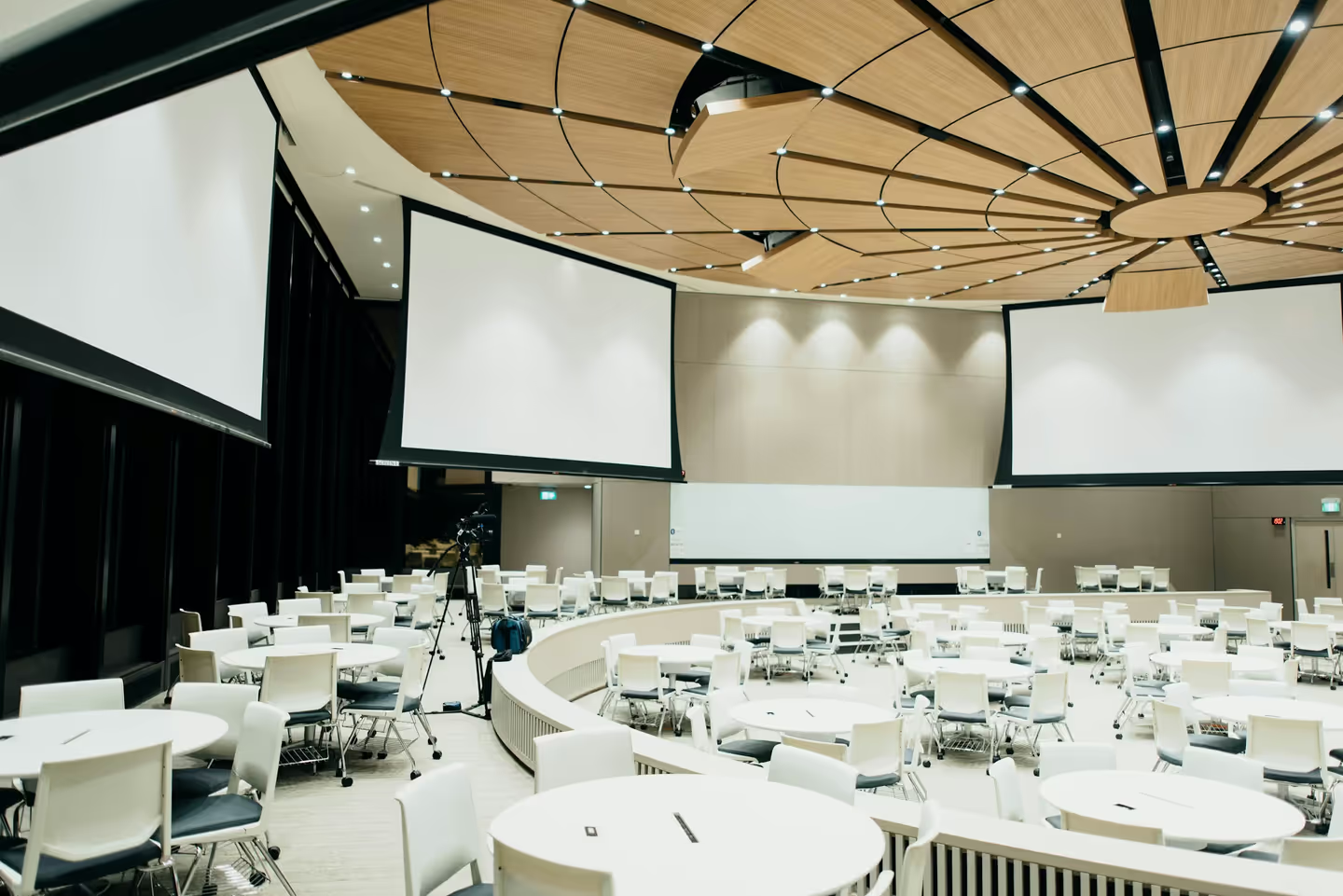
Breakout sessions organized around specific topics represent one of the most effective mechanisms for producing relevant connections. When participants self-select into groups based on shared interests or challenges, the relevance problem that plagues general networking largely disappears. Everyone in the room has demonstrated interest in the topic by their presence, creating natural conversational common ground that cold networking interactions lack.
Topic selection matters enormously for breakout effectiveness. Topics that are too broad attract diverse participants without clear common ground; topics that are too narrow attract few participants and may feel isolating. The sweet spot identifies specific challenges or interests shared by meaningful subsets of the broader audience—focused enough to ensure relevance, broad enough to enable participation.
Group size affects interaction dynamics in predictable ways. Very small groups—three to five people—enable intimate conversation but may feel intense and limit exposure to different perspectives. Very large groups—twenty or more—often default to presentation rather than conversation, with a few voices dominating while most participants remain passive. Groups of eight to twelve typically provide optimal balance, large enough for diverse perspectives but small enough that everyone can contribute meaningfully.
Facilitation technique determines whether breakout sessions produce genuine exchange or devolve into parallel monologues where participants wait for their turn to speak rather than actually engaging with others' contributions. Skilled facilitators ensure that conversation builds—that participants respond to each other rather than simply delivering prepared remarks. This facilitation requires active management: redirecting tangential contributions, drawing out quieter participants, and synthesizing themes that create coherence.
Outcome orientation transforms breakout sessions from pleasant conversations into productive work sessions. When groups are asked to produce something—a shared challenge definition, potential collaboration opportunities, or action commitments—the conversation takes on different quality than when discussion remains purely exploratory. This outcome focus doesn't require abandoning genuine exchange for forced deliverables; it simply channels natural conversation toward concrete conclusions.
The physical setup of breakout spaces affects interaction quality in ways that often go unexamined. Classroom-style seating with participants facing forward encourages passive listening rather than active engagement. Circular or semicircular arrangements that enable eye contact among all participants support conversation more effectively. Tables provide surfaces for materials and create psychological boundaries that may either support focused discussion or inhibit the informality that genuine exchange requires, depending on context.
Documentation of breakout discussions enables value extraction that purely conversational sessions miss. When key insights, connections identified, and follow-up commitments are captured—either by facilitators or by designated participants—the session produces artifacts that support continued engagement. Without documentation, valuable discussions often fail to produce lasting impact because specifics fade from memory within days.
The initial moments of networking interactions often determine whether genuine connection becomes possible. Traditional networking leaves these moments to chance—people approach each other with minimal information and default to safe, superficial topics that rarely reveal anything enabling genuine connection. Guided introductions address this challenge by providing conversational starting points that bypass small talk and enable substantive exchange from the beginning.
Peer matching based on complementary interests or challenges represents one powerful introduction format. When event organizers gather information about participant interests and use that information to suggest specific connections, the relevance of resulting introductions increases dramatically. Someone introduced to a peer facing similar scaling challenges has obvious conversational territory to explore; someone introduced randomly has only generic professional information to work with.
Interest-based introductions work similarly by clustering people around specific topics before conversation begins. Rather than approaching strangers with nothing in common, participants approach others who have indicated shared interest in particular subjects. This shared interest provides instant common ground that accelerates the movement from introduction to genuine exchange.
Moderated round-robin formats provide structure that some participants find liberating. When a facilitator manages introductions—setting topics, timing transitions, and ensuring everyone speaks—the social anxiety that prevents some people from networking effectively is substantially reduced. The structure provides permission to engage that unstructured environments don't offer.
The depth of information shared in introductions affects subsequent conversation possibilities. Introductions that include only name and company provide minimal conversational hooks. Introductions that reveal challenges, interests, or specific expertise create multiple potential directions for deeper conversation. Event designs that encourage or require more substantive introductions produce more substantive subsequent interactions.
Following McKinsey's research on collaboration and organizational performance, the most productive professional relationships often form when people discover unexpected commonalities or complementary capabilities. Guided introductions that surface these connections deliberately produce relationship formation rates that random networking cannot match.
The role of technology in facilitating introductions has expanded significantly through apps and platforms that enable pre-event connection and in-event matching. When participants can browse attendee profiles before events and identify people they'd like to meet, introductions become more intentional. When apps suggest matches based on profile analysis, serendipitous connections that manual processes might miss become possible. These technologies augment rather than replace human connection, providing scaffolding that supports more effective relationship formation.
Follow-through mechanisms that connect introduction to ongoing relationship deserve explicit attention. Introductions that end without clear next steps often fail to produce lasting connection despite initial promise. Formats that include explicit invitation to exchange contact information, schedule follow-up conversation, or connect on professional platforms convert introductions into relationships more effectively than those leaving follow-through to chance.
Collaborative activities that incorporate games-workshop elements have emerged as particularly effective mechanisms for rapid relationship formation. The shared focus on challenge completion creates natural connection that purely conversational formats often struggle to produce. When people work together toward common goals—even artificial ones—they reveal aspects of themselves that conversation alone might not surface and build trust through demonstrated capability and cooperation.
The psychological mechanisms underlying activity-based connection are well documented. Shared experiences create bonding that shared conversation cannot replicate. The collaborative problem-solving required by workshop activities produces mutual investment in outcomes that passive attendance at presentations never achieves. The mild stress of challenge completion triggers social bonding responses that comfortable environments don't activate.
Hierarchy flattening represents one of the most valuable effects of collaborative games-workshop formats. In conversational networking, status differences often constrain interaction—junior participants hesitate to approach senior ones, and conversations follow predictable patterns reflecting organizational position. Collaborative activities that focus attention on the task rather than the participants' relative status enable connections that hierarchical awareness would otherwise prevent.
Design thinking exercises exemplify how structured activities can produce both immediate value and lasting connections. When participants work together to analyze problems, generate solutions, and prototype responses, they learn about each other's thinking styles, expertise, and collaborative preferences in ways that conversation alone rarely reveals. These insights provide foundation for ongoing relationship development.
The playful dimension of games-workshop approaches matters more than it might initially appear. Play lowers defenses and encourages experimentation that purely professional contexts inhibit. When networking feels like play rather than work, participants engage differently—more authentically, more creatively, and more openly. This engagement quality produces connections that feel different from those formed through conventional professional exchange.
The trust-building that collaborative activities produce accelerates relationship development significantly. Trust normally requires extended observation across multiple interactions; activities that reveal character through behavior compress this observation into concentrated periods. Someone who demonstrates reliability, creativity, or generosity during collaborative activities builds trust much faster than someone who merely claims these qualities in conversation.
The debriefing that follows collaborative activities often proves as valuable as the activities themselves. When participants reflect together on what they experienced, learned, and observed about each other, the implicit insights that activities generate become explicit. Skilled facilitation of debrief conversations surfaces connection opportunities that might otherwise remain unrecognized.
Activity design requires careful calibration to participant characteristics and event objectives. Activities that are too simple feel patronizing to sophisticated participants; activities that are too complex create frustration that undermines connection. Activities that align with professional contexts feel relevant; activities that seem disconnected from professional concerns may produce bonding but not business-relevant relationship formation.
The expansion of networking beyond physical spaces through Zoom events and other virtual formats has permanently changed the networking landscape. What began as pandemic necessity has become recognized as valuable complement to in-person connection, enabling relationship maintenance and development that geographic constraints would otherwise prevent. The most effective contemporary networking strategies integrate virtual and physical formats rather than treating them as separate domains.
Virtual networking addresses access limitations that physical events cannot overcome. Participants who cannot travel, who face scheduling constraints, or who simply prefer digital interaction can engage through virtual formats in ways that physical-only events would exclude. This expanded access produces more diverse participation and enables connections across geographic boundaries that previously required significant investment to achieve.
Zoom events and similar platforms offer specific features that support networking when used thoughtfully. Breakout rooms enable small-group conversations that replicate the intimacy of in-person breakout sessions. Chat functionality allows simultaneous backchannel conversation that can surface connection opportunities that main sessions might miss. Recording capabilities enable asynchronous participation that accommodates different schedules and time zones.
The official Zoom Events platform provides tools specifically designed for networking within virtual events. The platform's features support the structured-yet-flexible approach that effective networking requires, enabling organizers to create experiences that balance programming with interaction opportunities.
Hybrid formats that combine physical and virtual elements present both opportunities and challenges. Done well, hybrid extends access while maintaining the energy of in-person gathering. Done poorly, hybrid creates two separate experiences that fail to integrate, leaving virtual participants feeling like second-class attendees. Successful hybrid design requires intentional connection between physical and virtual spaces rather than simply broadcasting physical content to remote viewers.
Asynchronous follow-up mechanisms extend networking beyond event boundaries. When participants can continue conversations through digital channels after events conclude, the time constraints that limit in-person interaction become less binding. Relationships that form at events can develop through subsequent digital exchange in ways that pre-digital networking couldn't support.
The technical quality of virtual experiences affects networking outcomes significantly. Poor audio, unstable connections, and confusing interfaces create friction that inhibits the natural flow of conversation. Investing in technical infrastructure and providing clear guidance for participants produces substantially better networking outcomes than hoping technology will work without attention.
Virtual networking requires different facilitation approaches than physical events demand. The cues that facilitators rely on in physical spaces—body language, spatial positioning, energy levels—are largely invisible in virtual environments. Effective virtual facilitation develops alternative mechanisms for reading participant engagement and adjusting accordingly. This facilitation skill set differs enough from physical event facilitation that expertise in one doesn't automatically transfer to the other.
The fatigue that extended virtual interaction produces—commonly called "Zoom fatigue"—requires acknowledgment in event design. Shorter sessions, more frequent breaks, and varied activity formats help manage fatigue that would otherwise undermine participant engagement. Virtual events that ignore fatigue dynamics by replicating physical event duration often produce diminishing returns as participants disengage from exhaustion.
Strong event organization transforms networking from occasional activity into repeatable business asset. When events are designed, executed, and followed up systematically, they produce compounding returns that ad-hoc networking efforts cannot match. Each well-run event builds community, generates data about what works, and creates expectations that attract participants to future iterations.
Planning processes determine event outcomes more than most organizers recognize. Events that are designed thoughtfully—with clear objectives, participant personas, and experience mapping—produce different results than events thrown together from generic templates. The investment of planning time yields returns through higher-quality experiences that participants value and remember.
Facilitation capabilities affect experience quality throughout events. Even well-designed events can fail through poor facilitation, while skilled facilitators can salvage events whose design is imperfect. Building facilitation capacity—either internally or through partnerships with professional facilitators—represents valuable investment for organizations that rely on networking events.
Follow-up systems distinguish organizations that extract full value from events from those that leave significant value unrealized. When participants receive personalized follow-up connecting them with people they should meet, highlighting resources relevant to their expressed interests, and facilitating continued conversation with people they met, event impact extends far beyond the event itself. Organizations that treat the event as the beginning rather than the end of relationship development achieve dramatically better outcomes.
Data collection and analysis enable continuous improvement that compounds over time. When organizers systematically gather information about what worked and what didn't—through surveys, observation, and outcome tracking—each event informs the next. This iterative improvement produces events that become increasingly effective, building reputation that attracts better participants and creates virtuous cycles.
Repeatability through documented processes enables scaling that personality-dependent event management cannot achieve. When events depend on specific individuals' instincts and relationships, scaling or succession becomes problematic. When processes are documented and systems are built, the knowledge that produces successful events can be transferred and multiplied.
Budget allocation for networking events deserves strategic consideration rather than arbitrary determination. Events that produce measurable business outcomes justify investment that merely pleasant gatherings cannot. Understanding the return on investment that well-designed networking produces enables appropriate resource allocation that maximizes impact.
Vendor and partner relationships affect event quality in ways that extend beyond obvious service provision. Venues that understand networking needs differ from those optimized for presentations or entertainment. Catering that supports conversation differs from catering that prioritizes efficiency. Technology providers that enable interaction differ from those focused solely on broadcast. Building relationships with vendors who understand networking objectives produces better outcomes than treating vendor selection as purely transactional.
The ultimate purpose of networking isn't accumulating contacts—it's enabling collaboration that produces outcomes neither party could achieve alone. This reframing fundamentally changes how networking success should be measured and how networking events should be designed. When collaboration becomes the goal, everything from participant selection to format design to follow-up processes shifts accordingly.
Partnership formation represents one of the most valuable collaboration outcomes that networking can produce. When participants with complementary capabilities find each other and structure ongoing relationships, networking achieves its highest potential. These partnerships might involve formal business arrangements, informal referral relationships, or collaborative project development—what matters is that capabilities combine to create value that wouldn't otherwise exist.
Referral networks emerge naturally from relationship-focused networking as participants come to understand each other's capabilities well enough to recommend appropriate connections. These referrals carry credibility that cold outreach cannot match, producing conversion rates that justify the relationship investment that enabled them. Building referral capacity requires the depth of understanding that superficial networking never achieves.
Co-creation opportunities—jointly developed products, services, or initiatives—represent collaboration at its most productive. When networking produces partnerships that build new offerings combining multiple parties' strengths, value creation reaches levels that purely transactional relationships cannot approach. These opportunities rarely emerge from single interactions; they develop through relationships that deepen over time through repeated engagement.
Shared initiatives around common challenges enable collaboration even among potential competitors. When participants recognize that certain challenges are better addressed collectively—industry-wide issues, ecosystem development, or standard-setting—networking provides the relationship foundation for collective action. These shared initiatives often produce industry-level benefits while strengthening relationships among participants.
Knowledge exchange represents valuable collaboration even when formal partnership doesn't result. When participants share insights, experiences, and perspectives that inform each other's decision-making, value is created that enhances both parties' capabilities. This exchange requires the trust that superficial networking cannot produce—willingness to share honestly rather than performing competence.
The pipeline from initial connection to active collaboration typically involves multiple stages that effective networking supports. Awareness leads to familiarity; familiarity enables trust development; trust permits genuine exchange; genuine exchange reveals collaboration opportunities; opportunities lead to joint action. Understanding this pipeline helps design networking experiences that advance relationships through stages rather than expecting immediate collaboration from initial contact.
Pattern recognition across unsuccessful networking efforts reveals common mistakes that consistently limit outcomes. Understanding these pitfalls enables proactive avoidance rather than learning through repeated disappointing experiences.
Overpacked agendas leave no time for the unstructured interaction that genuine connection requires. When every minute is scheduled with presentations, panels, and programmed activities, participants have no opportunity to follow conversational threads that interest them or deepen connections that form during structured activities. Effective event design includes substantial unstructured time, treating it as essential programming rather than filler between the "real" content.
Unclear purpose leaves participants uncertain what kinds of interactions are appropriate or valued. Events that try to be everything to everyone typically fail to serve anyone well. Specific purpose—clearly communicated before and during events—helps participants engage appropriately and attracts those most likely to benefit from and contribute to the particular event.
Insufficient facilitation leaves participants to navigate social uncertainty alone. While heavy-handed facilitation creates its own problems, absent facilitation abandons participants without the guidance many need to engage effectively. Skilled, light-touch facilitation that models behavior, creates permission, and connects people who should meet dramatically improves outcomes.
Missing post-event follow-up wastes the relationship potential that events create. When participants leave events without clear pathways for continuing conversations, the momentum that events generate dissipates rapidly. Systematic follow-up—both from organizers and between participants—converts event-generated connection into ongoing relationship.
Misaligned participant composition undermines networking before it begins. When events attract people without natural connection points—different industries, different scales, different interests—even perfect execution cannot overcome fundamental relevance problems. Thoughtful participant curation, even at the cost of raw attendance numbers, produces dramatically better outcomes.
Excessive focus on quantity over quality produces the volume-without-value outcomes that give networking its poor reputation. When success is measured by attendance or contacts collected rather than connections formed and collaborations initiated, incentives push toward behaviors that undermine genuine relationship formation.
Neglecting introvert needs excludes participants whose networking preferences differ from extrovert-optimized defaults. Introverts often form deeper connections than extroverts when given appropriate conditions—smaller groups, substantive topics, and recovery time between intensive interactions. Events that accommodate these preferences access talent and perspective that extrovert-only designs exclude.
Failure to create psychological safety prevents the vulnerability that genuine connection requires. When participants feel judged, evaluated, or at risk of exploitation, they present polished professional personas rather than authentic selves. This performance produces shallow connections that rarely develop into meaningful relationships.
Evaluating networking effectiveness requires metrics that capture relationship quality and collaboration outcomes rather than merely counting contacts or measuring satisfaction with events. This measurement challenge explains why many organizations under-invest in networking—they lack the metrics needed to demonstrate returns that would justify greater investment.
Relationship depth—measured through interaction frequency, exchange quality, and mutual investment—provides more meaningful assessment than connection counts. Ten relationships where parties actively support each other's success outperform hundreds of dormant connections that never progress beyond initial contact. Tracking relationship development over time reveals whether networking is producing the depth that collaboration requires.
Follow-up engagement rates indicate whether events are producing connection worth continuing. When high percentages of participants follow up with people they met—and when those follow-ups lead to ongoing exchange—events are achieving their purpose. When follow-up is minimal or perfunctory, something in the event design or participant composition is failing.
Collaboration outcomes—partnerships formed, referrals exchanged, projects initiated—represent the ultimate measures of networking success. These outcomes often emerge months after initial events, requiring tracking systems that connect eventual collaborations back to their networking origins. Organizations that implement this tracking can calculate actual returns on networking investment rather than hoping that vague "relationship value" justifies continued effort.
Repeat participation rates indicate whether events are delivering value that justifies continued investment of participant time. When participants return repeatedly, they're signaling that previous experiences produced sufficient value to warrant another investment. When participation declines over time, something about the experience is failing to meet expectations.
Net promoter scores and qualitative feedback provide insight into experience quality that outcome metrics alone might miss. Participants who enthusiastically recommend events to peers are experiencing something valuable even if specific collaboration outcomes remain pending. This enthusiasm typically predicts future value creation even when immediate outcomes aren't yet visible.
Attribution challenges complicate networking measurement, as outcomes often result from relationship combinations rather than single connections. The partnership that transforms a business might trace back through multiple relationship chains to networking events years earlier. Comprehensive tracking that captures relationship origins and development enables this attribution even when causal chains are complex.
Networking produces its greatest returns when treated as ongoing strategic capability rather than occasional activity. Organizations that integrate networking into their broader business strategy—with dedicated resources, systematic processes, and continuous improvement—achieve results that ad-hoc approaches cannot match.
Resource allocation decisions signal organizational commitment to networking as growth strategy. When networking receives dedicated budget, designated responsibility, and protected time, it receives the investment required for excellence. When networking competes for attention with other responsibilities and receives resources only when convenient, results reflect that marginal commitment.
Process development converts individual networking skill into organizational capability. When successful approaches are documented, trained, and systematically deployed, networking effectiveness scales beyond what individual practitioners can achieve alone. This process development requires treating networking as discipline worthy of systematic improvement rather than natural talent that some possess and others lack.
Technology infrastructure enables networking at scales that purely relationship-driven approaches cannot achieve. CRM systems that track connections, communication tools that enable follow-up, and analytics platforms that measure outcomes all contribute to networking effectiveness. The technology investment appropriate for any organization depends on networking's role in its growth strategy—but most organizations under-invest relative to the potential returns.
Community development around recurring events creates compounding value that single events cannot match. When the same participants gather repeatedly, relationships deepen over time in ways that one-off events cannot produce. Organizations that build communities rather than just hosting events achieve dramatically better long-term outcomes.
Strategic integration connects networking to other business development activities. When networking feeds into sales processes, partnership development, and market intelligence gathering, its value multiplies beyond direct relationship outcomes. This integration requires intentional design—networking rarely integrates automatically into other functions without explicit effort.
Talent development ensures that networking capabilities persist beyond any individual contributor. When organizations invest in training, mentoring, and skill development around networking, capability becomes institutional rather than personal. This development investment protects against the knowledge loss that departure of skilled networkers would otherwise create.
Business networking continues to evolve as technology, work patterns, and professional expectations change. Understanding emerging trends helps organizations prepare for a networking landscape that may look quite different from today's while retaining the fundamental human dynamics that drive relationship formation.
The permanent integration of virtual and physical networking formats has become clear. Rather than one format replacing the other, hybrid approaches that leverage the strengths of each will dominate. Physical gathering provides energy, spontaneity, and relationship depth that virtual cannot replicate; virtual extends access, enables asynchronous engagement, and maintains relationships between physical gatherings. Effective networking strategies will integrate both.
Community-based models are displacing event-based models as primary networking frameworks. Rather than periodic gatherings of strangers, ongoing communities of aligned professionals provide context for relationship development that happens continuously. Events serve as community intensification rather than as standalone networking opportunities.
Data and AI applications are beginning to inform networking by identifying connection opportunities that human observation might miss. Systems that analyze participant profiles, interaction patterns, and collaboration histories can surface potential connections that wouldn't emerge through random mixing. These tools augment rather than replace human relationship formation, providing recommendations that participants can accept or ignore.
The demand for demonstrated outcomes is increasing as networking competes with other uses of professional time. Participants expect clear value from their networking investments and will abandon approaches that fail to deliver. This pressure pushes toward more intentional, outcome-focused approaches and away from social networking that prioritizes pleasant gathering over productive connection.
Personalization expectations are rising as participants grow accustomed to tailored experiences in other domains. Generic networking events that treat all participants identically will lose ground to approaches that recognize individual interests, preferences, and goals. Technology that enables personalization at scale will become increasingly important for event organizers seeking competitive advantage.
Sustainability considerations are influencing event design as awareness of environmental impact grows. Travel-intensive networking models face scrutiny that purely virtual or regional approaches avoid. Organizations balancing networking effectiveness against environmental responsibility will increasingly favor formats that minimize carbon footprint while maintaining relationship-building capability.
When networking events are thoughtfully designed—with structure that guides without constraining, formats that reveal genuine common ground, and follow-up systems that extend connection beyond event boundaries—they become powerful engines for real business growth. Collaboration emerges naturally when the right people find each other in contexts conducive to genuine exchange. The challenge isn't convincing professionals that networking matters—it's designing networking experiences worthy of their investment and capable of producing the outcomes they seek.
23.01.2024
23.01.2024
23.01.2024
23.01.2024
23.01.2024